There are lines from games that survive because they are dramatic. There are lines that survive because they are funny. And then there are lines that survive because millions of people encountered them at exactly the wrong moment.
“Our princess is in another castle” belongs to the third category.
In the original Super Mario Bros., the message appears after Mario clears a castle only to discover that the person he came to rescue is somewhere else. The structure is simple: victory, interruption, reset. You did the work. You reached what looked like the ending. The game congratulated you and immediately informed you that none of it was enough.
THE PERFECT FALSE ENDING
That rhythm is why the line matters more than its literal function. It is not really about a princess. It is about being told that the thing you thought you had reached was only another checkpoint.
Games are full of gates, keys, bosses and temporary victories, but this particular message distilled that structure into one sentence. It gave language to the feeling of arriving somewhere important and finding out the real destination had moved again.
It is disappointment packaged as momentum.
That is unusually durable cultural material. You can use the reference in work, dating, technology, travel, bureaucracy or almost any situation where the finish line turns out to be fake. The line escaped the game because the feeling was bigger than the game.
REPETITION MADE IT STICK
A lot of memorable game dialogue is attached to one cinematic moment. This was different. Players encountered the idea repeatedly. That repetition made the message feel less like exposition and more like ritual.
Long before every phrase was screenshotted, clipped and distributed as a meme, games were already teaching people shared language through repetition. If enough players saw the same strange little sentence in the same frustrating situation, it became a cultural password.
You did not need to explain the setup. The reference carried its own emotional payload.
THE LINE WORKS EVEN AFTER YOU REMOVE THE GAME.
That is the difference between a reference and a logo. The best pieces of cultural language still mean something when the original box art is nowhere in sight.
FROM MESSAGE TO OBJECT
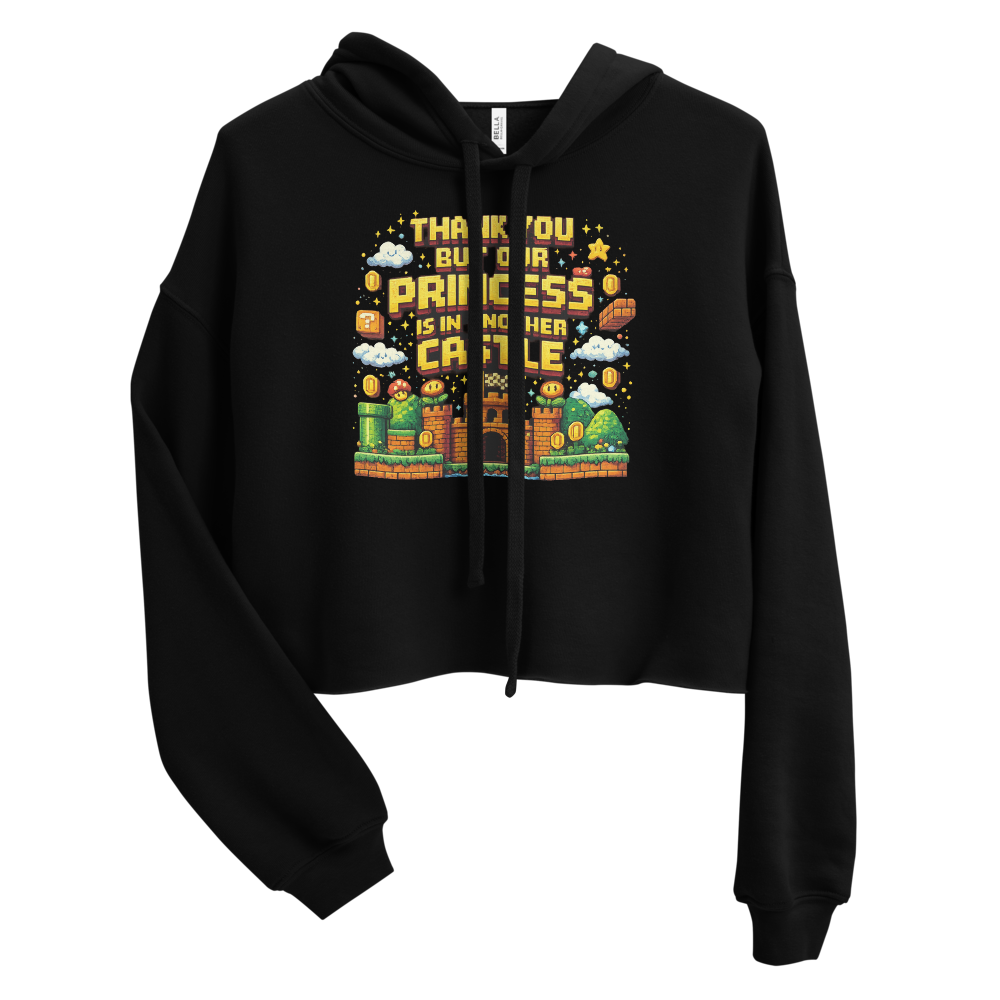
That distinction is the reason the line became the starting point for Kulture Vulchr’s first Drop.
We were less interested in making “gaming merch” than in treating a piece of game language the way fashion treats any other cultural symbol. No giant character art. No need to explain the joke. The text itself is the artifact.
If you recognize it, you bring the memory with you. If you do not, it still reads as a strange, slightly hostile statement about being somewhere you are not supposed to be.
That tension is useful. It lets the design exist as clothing first and reference second.
WHY IT STILL WORKS
Nostalgia is usually described as a desire to return to the past, but that is only part of it. Often what we actually miss is the density of meaning attached to small things: startup sounds, menu screens, error messages, box art, controller shapes, badly compressed voice clips and one-line messages that lived in our heads because there was less media competing for the space.
“Our princess is in another castle” is tiny. That is exactly why it survived. It did not need lore. It did not need a cinematic universe. It needed a few seconds, a castle, and the realization that you were not done yet.
THE REFERENCE IS THE POINT.
Drop 001 turns the line into a wearable cultural signal, built around recognition rather than character branding.
Kulture note: this piece is cultural commentary on the language and design legacy of classic games. Kulture Vulchr is not affiliated with Nintendo.